 Teacher's Community
  Support


Laser vs. Lamp Projectors: What Changes When You Upgrade
- Sep 17, 2026
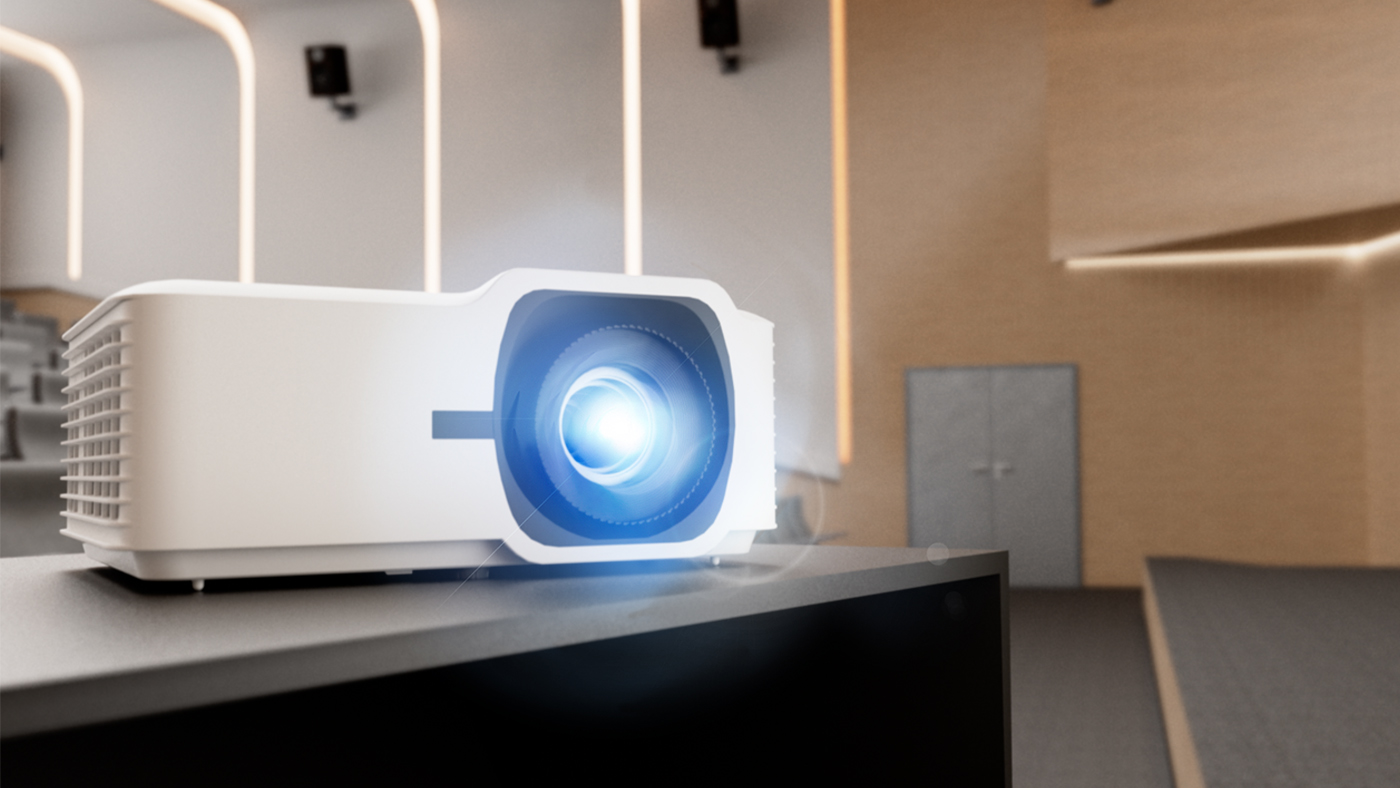
Laser vs. Lamp Projectors: What Changes When You Upgrade
A laser projector uses a solid-state light source instead of a mercury lamp. That means no bulb to replace, no warm-up wait and no lamp disposal, in exchange for a higher price up front.
For a room that runs six hours a day, that trade is usually worth making. For a room used twice a week, it usually isn't.
Here's how the two compare, what the lifespan numbers actually mean and which rooms should get a projector at all.
What is a laser projector, and how does it work?
A laser projector generates its image using a laser or laser-LED light source rather than a mercury arc lamp. The light source is solid-state, so there's no consumable part that burns out and needs swapping. Three practical differences follow from that. It turns on and off almost instantly instead of warming up and cooling down. It contains no mercury, so spent lamp disposal stops being part of the lifecycle. And its brightness declines gradually across tens of thousands of hours rather than dropping off within a few thousand.
Laser vs. lamp projectors: what actually changes
| Laser projector | Lamp projector | |
| Light source life | Up to 20,000 hours in normal mode and 30,000 in eco | Typically a few thousand hours |
| Consumables | None | Lamp, and often a filter |
| Warm-up and cool-down | Near instant on and off | Warm-up and cool-down cycle |
| Brightness over time | Stays near full brightness through the full 20,000–30,000 hour life | Declines faster over a much shorter period of time |
| Mercury content | None | Yes |
| Maintenance labor | Minimal | Lamp swaps, plus lift access in high-mount rooms |
| Upfront cost | Higher | Lower |
| Best fit | High-use rooms, hard-to-reach mounts | Low-use rooms, tight upfront budgets |
The last row matters. A lamp projector in a seldom-used seminar room can still be the right purchase. The laser case gets stronger the more hours the room runs and the harder the projector is to reach.
How long does a laser projector actually last?
A laser projector's light source lasts for about 20,000 hours in standard mode and up to 30,000 hours in eco mode. At 6 hours a day for 180 school days a year, 20,000 hours equates to over 18 years of use. In practice, schools replace projectors due to outdated technology or expired warranties long before the light source fails.
Does a laser projector cost less than a lamp projector over time?
In a high-use room, usually yes, and the savings come from both parts and labor.
The upfront price is higher. What goes away afterward is the recurring spend:
- Replacement lamps, at every few thousand hours of use, multiplied by every projector in the fleet.
- Filters, on models that use them. Sealed-engine designs remove this task entirely.
- The labor to do the swap. In a classroom that's a short job. In an auditorium with a ceiling mount, it's a lift, a scheduling window and often two people. That's the cost most TCO comparisons leave out.
- Lamp disposal. Projector lamps contain mercury, so spent lamps are handled as regulated waste rather than thrown out. A laser fleet takes that off the list.
- Energy, since laser light sources generally draw less power for the same brightness.
Build the comparison per room, not per unit. A projector mounted 20 feet up in a lecture hall that runs all day has completely different math than a cart-mounted unit in a room used for testing three times a year.
When is a projector the right choice, and when isn't it?
This is the question worth answering before the laser question. Projectors, interactive flat panels and direct view LED each win in different rooms.
- Standard classroom, up to about 30 students. An interactive flat panel is usually the better answer. No throw distance to calculate, no ambient light problem, no shadow when a teacher stands at the board, and the surface is touch-enabled.
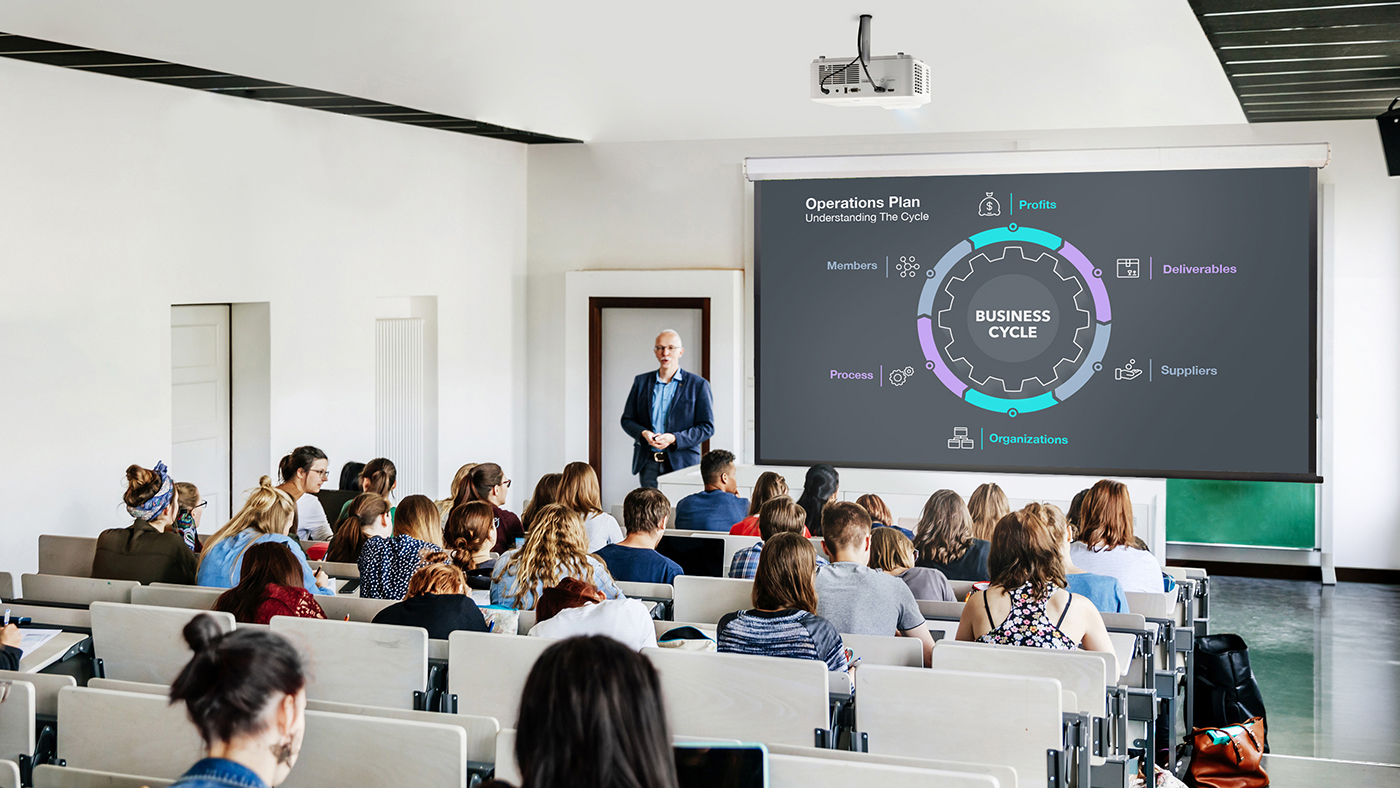
- Lecture hall, auditorium, chapel, gym, large multipurpose room. A projector wins, because image size past roughly 100 inches is where flat panels stop being practical or affordable.
- Large permanent installation with high ambient light. Direct view LED is worth pricing, particularly where the display stays on all day and brightness matters more than install cost.
- A big writable surface on a tight budget. A short-throw laser projector paired with a whiteboard covers this at a lower cost than a comparable panel.
If your refresh plan currently replaces every projector with a projector, that's the decision worth revisiting first. Some of those rooms are panel rooms now.
What should IT check before specifying a laser projector?
Seven things, in order of importance.
- Ambient light in the actual room. Brightness requirements depend on the light you can't control and the screen size you need. Measure the room before you spec, and ask for a recommendation based on those measurements rather than a general lumen number.
- Throw distance and mounting. Confirm the throw ratio works with your existing mount points. The LS921WU runs 0.81 to 0.89 with 1.1x optical zoom, which is short-throw territory. Retrofitting mounts is a bigger line item than the projector.
- Filter-free design. Ask whether the optical engine is sealed. The LS921WU uses a sealed optical engine rated IP5X, which means no filter to clean and no dust ingress on the light path. That removes the other recurring maintenance task.
- Network control and monitoring. Confirm the projector speaks the protocol your AV or IT team already runs so it can be monitored and powered on a schedule. The LS921WU is certified for Crestron and Q-SYS and compatible with AMX, PJLink, ATEN and Extron, with RS-232 and RJ45 LAN control on board.
- Orientation flexibility. Portrait, tilted and 360-degree installation matters for non-standard rooms. The LS921WU supports 360-degree projection and a 90-degree portrait mode.
- Noise level. In a small room, fan noise competes with the instructor. Ask for the dB figure in both modes. The LS921WU is rated 36dB in normal mode and 29dB in eco.
- Warranty on the light source specifically. Light source coverage and chassis coverage are sometimes different terms. Get both in writing.
Which rooms should you upgrade first?
Start with the rooms where the maintenance burden is highest, not the ones with the oldest equipment.
- Rooms that already need frequent lamp or filter service.
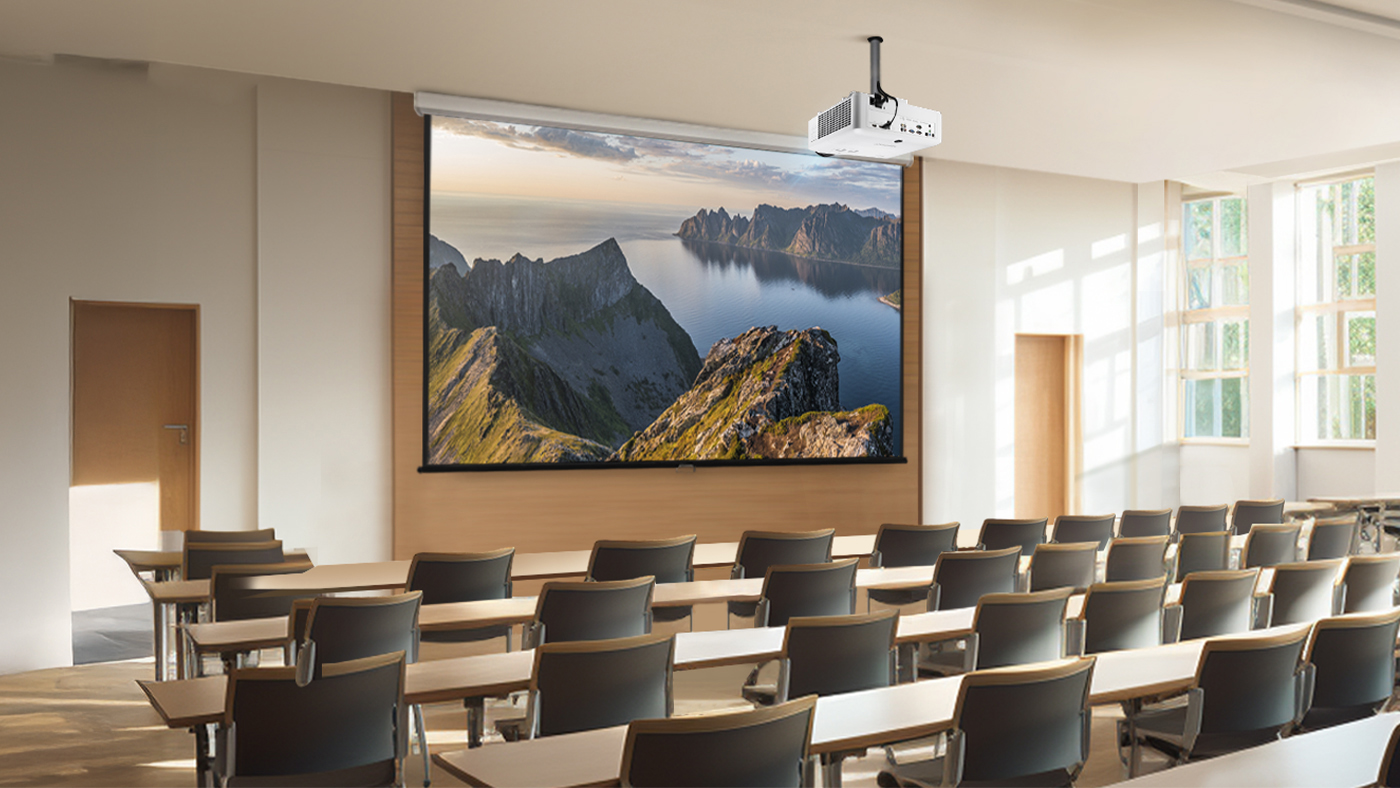
- Rooms with high ceilings or difficult mounts, where every service call means lift access.
- High-use spaces: lecture halls, auditoriums and any room booked most of the day.
- New hybrid rooms being built out, where you're specifying from scratch anyway.
- Campuses with sustainability reporting requirements, since laser units remove mercury from the fleet and draw less power.
Why ViewSonic projectors for education?
ViewSonic entered the projector market in 1999, and the current business installation line is laser throughout.
The range covers most room types:
| Model | Brightness | Resolution |
| LS740W | 5,000 ANSI lumens | WXGA |
| LS740HD | 5,500 ANSI lumens | 1080p |
| LS832WU | 5,000 ANSI lumens | WUXGA |
| LS921WU | 6,000 ANSI lumens | WUXGA, short throw |
| LS901-4K | 5,500 ANSI lumens | 4K |
| LSD400W | 4,000 ANSI lumens | WXGA |
| LSD400HD-ST | 4,000 ANSI lumens | 1080p, short throw |
| LSD500HD | 5,500 ANSI lumens | 1080p |
| LSD600W | 6,000 ANSI lumens | WXGA |
| LSC731WU | 7,300 ANSI lumens | WUXGA |
| LSC731WU-ST | 7,300 ANSI lumens | WUXGA, short throw |
Frequently asked questions
Do laser projectors need bulb replacements?
No. The light source is solid-state, so there's no lamp to replace across the rated life of the unit. That removes both the part cost and the service visit.
How many lumens does a classroom projector need?
It depends on two things: how much ambient light the room has and how large the projected image needs to be. A room with uncovered windows and a 120-inch screen needs substantially more brightness than a controlled room with a 90-inch image. ViewSonic laser installation models range from 5,000 to 6,000 ANSI lumens, so ask for a recommendation based on your room measurements rather than picking a single number.
Do laser projectors contain mercury?
No. Mercury is used in traditional projector lamps, which is why spent lamps are handled as regulated waste. A laser light source removes that from your waste stream entirely.
Should we buy a projector or an interactive flat panel?
It depends on room size. For a standard classroom, an interactive flat panel is usually the better fit because it's touch-enabled and needs no throw distance or light control. For a lecture hall, auditorium or any room needing an image larger than roughly 100 inches, a projector remains the practical choice.
Are laser projectors better for hybrid classrooms?
They help in two specific ways. Instant on and off means class starts without a warm-up wait, and onsistent brightness and color across the life of the unit means a recorded or streamed session looks the same in week 30 as it did in week one.
Can laser projectors be managed over the network?
Yes. The LS921WU is certified for Crestron and Q-SYS and compatible with AMX, PJLink, ATEN and Extron, with RS-232 and RJ45 LAN control built in. That is what lets a campus AV team handle remote power, input switching and status monitoring without walking to each room. Confirm protocol support model by model.
How long does a laser light source last?
On the LS921WU, 20,000 hours in normal mode and 30,000 hours in eco mode. Always check which mode a published figure refers to, because the gap between the two is 10,000 hours on the same unit.

Match the technology to the room, then to the hours
Laser wins where the hours are long and the mount is hard to reach. Lamp still competes where the room is used rarely and the upfront budget is fixed. And some rooms on your projector refresh list shouldn't get a projector at all.
Send us your room list with sizes, ceiling heights and how many hours a day each space runs. We'll tell you which rooms should get a laser projector, which should get a panel and which can wait.
Contact Us
*Comparative statements and TCO estimations are based on general technology features and standard operating assumptions at the time of publication. Performance, energy savings, and sustainability outcomes may vary depending on system configuration, usage environment, agency requirements and other factors. Ceiling and wall suitability, structural reinforcement, load-bearing capacity, and professional installation using commercial-grade mounting hardware are the sole responsibility of the customer, installer, or system integrator. ViewSonic assumes no liability for equipment damage, property damage, or personal injury resulting from incorrect installation or failure to comply with local codes. Any references to third-party software, control systems, or corporate trademarks are for identification and compatibility purposes only and do not imply endorsement, affiliation, or sponsorship by their respective owners. Actual performance, compatibility, and user experience may vary depending on system configuration, network conditions, usage environment, and other factors. Programs, pricing, specifications, and availability are subject to change without notice. Selections, offers, and programs may vary by country. See your ViewSonic representative for complete details. Proper wall and ceiling suitability, reinforcement, and professional installation are the sole responsibility of the customer, installer, or system integrator; ViewSonic assumes no liability for equipment damage, property damage, or personal injury resulting from incorrect installation. Any references to third-party software, control systems, or corporate trademarks are for identification and compatibility purposes only and do not imply endorsement or affiliation. Corporate names and trademarks stated herein are the property of their respective companies. Copyright © 2026, ViewSonic Corporation. All rights reserved.
Related Posts
-

-
![Female using ViewBoards to instruct a group of employees in a large room]()
-
![Teacher instructing a room of students on Human Geography using a ViewSonic projector]()
-
![Instructor teaching class in front of a large room of students using a ViewSonic projector]()
-
![Instructor teaching class in front of a large room of students using a ViewSonic projector]()
-
![a crowd of people walking past a large projected image]()
-
![someone working on a laptop with a connected portable monitor]()





Login and Registration Form