 Teacher's Community
  Support
How ViewSonic Projection Powers the Cité des Sciences
- Oct 9, 2026
CASE STUDY
IMMERSIVE TECHNOLOGIES When the Museum Becomes an Experience
Immersive projection, virtual reality, video mapping, interactive screens, intelligent lighting, cybersecurity: technology is reinventing museum spaces and cultural mediation tools. Between audiovisual innovation, immersive experience, and heritage promotion, the museum is becoming an interactive environment serving new uses and new audiences.
Introduction — The Museum in the Age of Immersion
Long associated with conservation and contemplation, the museum is now evolving toward more immersive and interactive forms of mediation. Video projection, dynamic screens, spatialized sound, motion capture, virtual reality, and scenographic lighting now hold a growing place in cultural experiences. These technologies do not replace the works or the scientific content, but enrich the modes of narration and transform the visit experience. This evolution accompanies the public's new expectations. Accustomed to digital uses and sophisticated audiovisual environments, visitors seek sensory, collective, and engaging experiences. Cultural institutions must therefore reconcile scientific rigor, accessibility, and appeal. Contemporary museography thus becomes a meeting ground between scenography, audiovisual, IT, and networks.
Immersion as a Mediation Tool
Immersive technologies open new possibilities for transmission. At the Cité des Sciences et de l'Industrie, video projectors, motion sensors, and interactive devices transform the visitor's body into a tool for expression and interaction. In the collective VR experiences developed by Excurio, participants explore historical or scientific environments reconstructed with a high level of accuracy. The projected image, screens integrated into the scenography, video mapping, and sound spatialization thus become genuine tools of cultural mediation. The quality of lighting is also an essential concern. New-generation LED solutions seek to reconcile faithful color rendering, visual comfort, and the preservation of works sensitive to light. Behind these experiences lies an increasingly essential technical infrastructure: IP networks, media servers, real-time processing, storage, and cybersecurity. Because cultural heritage is now also digital. Images, videos, scenographic content, and archives must be protected against the risks of loss or cyberattack.
Through this dossier, Smart Intégrations Mag offers a panorama of this rapidly evolving technological museography, where audiovisual, screens, IT, and immersion combine to transform cultural venues into interactive and connected spaces.
Cité des Sciences et de l'Industrie
Projection as a Mediation Tool
La Villette, a major player in scientific and technical mediation in Europe, has the mission of making all knowledge accessible to every audience, particularly the youngest. The immersive scenography of the “Danser” (Dance) exhibition puts this “powerful vector of communication and expression” into action by drawing on interactive video.
The deployment of video projectors across the various animation points rests on close collaboration between the internal multimedia design teams and the audiovisual provider Videlio, responsible for installation and maintenance. An in-house technical control room additionally ensures operational continuity in the event of an incident. The hardware choices respond to multiple constraints: diversity of spaces, high ambient brightness due to large glazed surfaces, and configurations that are sometimes atypical in terms of projection distance. In this context, ViewSonic projectors are used across a wide variety of models and configurations: front projection, rear projection, short and ultra-short throw. This flexibility makes it possible to place the image as close as possible to the interactive devices, while optimizing the footprint and discretion of the equipment. The out-of-nominal-range constraints — notably the unconventional distances between projector and projection surface — amount to a genuine stress test for the equipment, highlighting its robustness and adaptability.
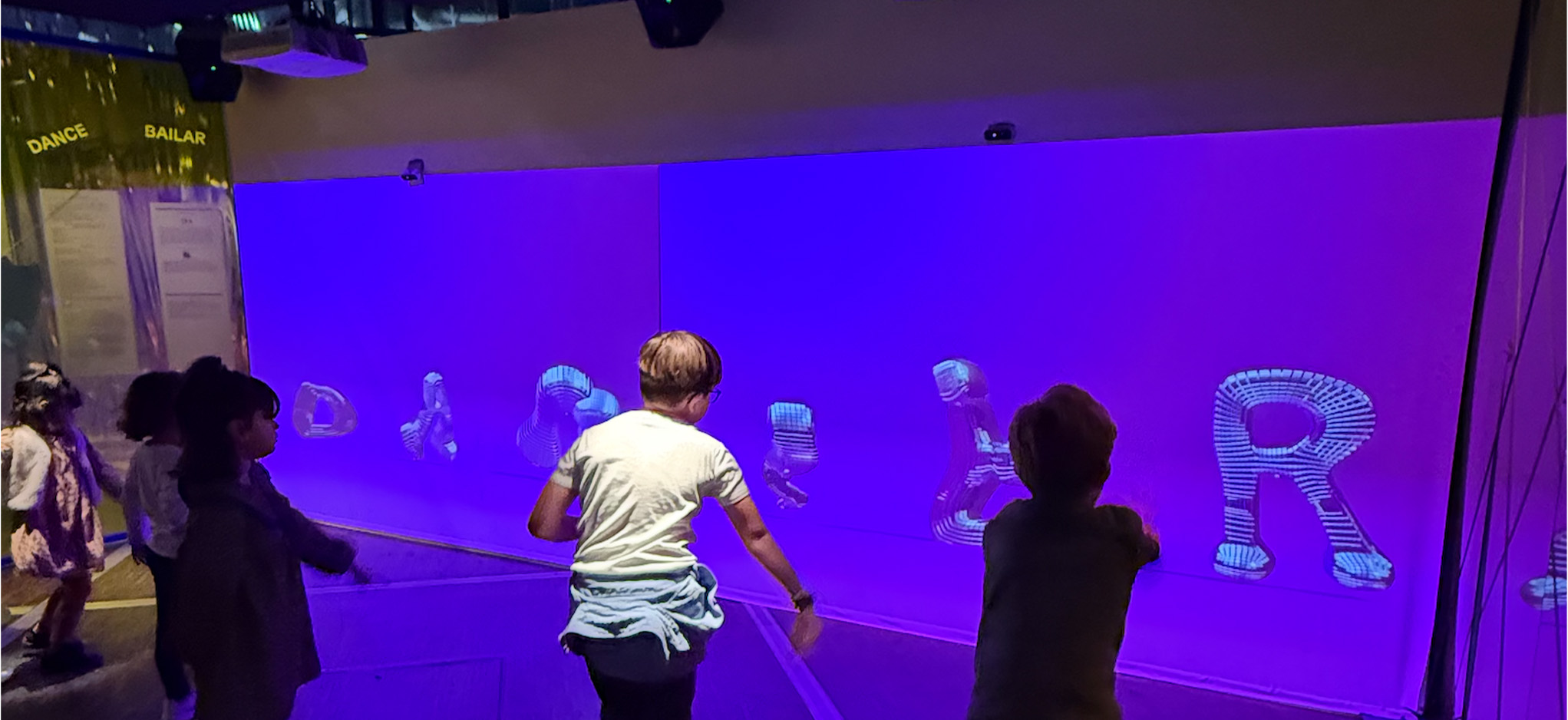
Motion Capture
The “Danser” exhibition perfectly illustrates a use case based on the integration of immersive technologies, combining projection and real-time interaction. The “Matière à danser” installation lets visitors manipulate animated letters on screen through the movement of their bodies. This system relies on the Azure Kinect motion sensor developed by Microsoft, now marketed by Orbbec. Initially aimed at the video game market, this technology has found a second wind thanks to the significant improvement in its tracking capabilities. Real-time processing of movements runs on Unity and Max MSP software (developed by Xavier Vielemans and Jean-Michel Couturier), executed on an i7 Z790 PC (16 GB DDR5, RTX 4070 Ti V2 graphics card) prepared by Inovio. The system translates visitors' movements into dynamic visual interactions, rendered as images by ultra-short-throw projectors such as the ViewSonic LS831WU, allowing display at very short distance with no cast shadow. With a brightness of 4,500 lumens and WUXGA resolution, this model guarantees optimal legibility. Its successor, the LS832WU, pushes performance to 5,000 lumens and a light-source lifespan reaching 30,000 hours. This projector is also deployed in other spaces of the Cité des Sciences. The sound environment is provided by Mackie MR824 monitoring speakers, ensuring faithful and immersive reproduction, essential to reinforcing the overall sensory experience.
Jean-François Lemercier — Multimedia and Audiovisual Engineering, Universcience
“At Universcience, I have three distinct missions on exhibitions: audiovisual and multimedia engineering, IT development, and technical coordination. For each exhibition whose technical design I handle, I work within several constraints: budget, quality, maintainability, robustness, routing, and accessibility. For “Danser,” I wanted to guarantee high audio quality by prioritizing the bandwidth and neutrality of the playback system, on a reasonable budget. A real challenge, given the venue's shortcomings in sound and acoustic isolation. On “Bal,” in addition to precise speaker positioning, sound engineer Thierry Bertomeu (Novapista) carried out an on-site mix to guarantee the best possible fidelity of the soundtrack composed by Florian Seraul.”
Cercles de danse
“In “Cercles de danse,” I compensated for the lack of acoustic treatment using The Tracks DSP 4x4 Mini Amp 4-way amplifiers, tuned with REW software and a Dayton Audio EMM-6 measurement microphone. The exhibition's visual and immersive dimension rests mainly on ViewSonic video projectors, when the focal lengths and brightness matched the needs. It's a brand I appreciate a great deal, because for tight budgets it offers many references with very decent projection quality. The ultra-short-throw LS832WU, for example, delivers a fine projection surface in confined spaces, with 5,000 lumens — sufficient in a controlled lighting environment — on a quality ShowTex projection screen (supplied and installed by the Edmond Petit company after comparative testing).”
Le Bal
“The cylindrical projection surfaces of “Bal” and “Cylindres de danse” are handled by Vioso 6 software, which — thanks to a GigE camera with a 185° wide-angle lens — automatically calibrates the mapping, overlaps, colorimetry, and uniformity of the blacks. Video playback in HAP format runs on Vioso's Exaplay 2, driven via OSC by the in-house-developed Patchway software. To direct visitors toward “Bal” every 30 minutes, this element is synchronized with “Grand Saut” and “Cercles de danse” via an IP network over UDP (User Datagram Protocol).”
Mapping and Spatialization
Another application of ViewSonic projectors in the “Danser” exhibition concerns video mapping. In the circular “Bal” space, nine LS711HD projectors are deployed to create a continuous visual environment through edge-blending and warping (image deformation) techniques. This configuration makes it possible to turn the perimeter of the space receiving visitors into an immersive projection surface. The mapping is driven via MadMapper software, recognized for its flexibility in creative environments, while rendering is managed by a media server developed by Vioso, Anystation 12-output, guaranteeing precise synchronization and alignment of the images. A Shuttle PC synchronizes the audiovisual streams under Visio 6 with a calibration kit and Exaplay 2 player. Audio playback uses 9 Mackie MR824 units with Presonus Temblor T10 subwoofers emulated via a Behringer UMC 1820 sound card on a NUC Core i3 PC. Show control is orchestrated by Patchbay software (SIP Conseil), developed for the exhibition by Jean-François Lemercier. Lighting is driven by a Phidget 1012 controller and a Sunlite-EC digital multiplexer. All of this equipment is integrated into discreet concealed racks that remain accessible for maintenance. This approach illustrates the importance of audiovisual engineering in the success of immersive systems: beyond simple projection, the goal is to design a coherent, robust, and engaging experience.
Thus, the integration of ViewSonic solutions at the Cité des Sciences et de l'Industrie demonstrates how projection technologies can become full-fledged narrative tools, serving scientific mediation and interactivity.
Some Equipment Deployed at the Cité des Sciences et de l'Industrie
ViewSonic
The LS711HD model is a short-throw installation video projector using a 3rd-generation laser and displaying 1080p resolution for a brightness of 4,200 ANSI lumens and high contrast, achieved thanks to a 0.65-inch DLP (TI) imager from Texas Instruments. The 0.49 short throw allows perfect blending of the edges of two images, with horizontal and vertical keystone correction, enabling 360° projection and portrait-mode display.
The LS832WU video projector is an ultra-short-throw installation model displaying WUXGA format, thanks to a 2nd-generation laser phosphor light source, ensuring 30,000 hours of operation and producing 5,000 lumens. The image can cover an ultra-wide screen up to 170 inches, with horizontal and vertical keystone adjustment offering, here too, greater installation flexibility. The device connects to the local network to ensure synchronized management between units.
Digital Projection
The E-Vision 5100 is a compact and powerful mono-DLP laser projector whose MultiAxis installation capability allows orientation in nearly any position. The unit features a fixed ultra-short-throw optic and a multitude of connectivity options.
Vioso
The Anystation Media is a high-performance server running on Exaplay or other third-party solutions, designed for demanding applications, offering unmatched output power and flexibility to suit complex configurations. The unit can drive an immersive installation totaling up to 16 synchronized WUXGA outputs, for real-time applications and even 8K dome projections. The Anystation HD version offers up to 8 4K outputs for video walls and immersive installations.
MadMapper
Born from a collaboration between the French installation studio 1024 Architecture and the Swiss developers GarageCube, MadMapper is software that handles high-resolution video up to 16K, drawn from multiple outputs displaying distinct parts of the composition. MadMapper includes advanced features such as 3D calibration, spatial scanning, LED scanning, live shader editing, and more.
Azure Kinect DK
Microsoft + Orbbec Azure Kinect DK is a development kit and an AI-sensor peripheral for computer vision and voice models. It includes a 12-megapixel RGB camera, another sensor for depth at 1 megapixel, an array of seven microphones at 360 degrees, and an orientation sensor.
Mackie
The MR824 model is an active nearfield speaker featuring an 8-inch woofer and a 1-inch tweeter, both amplified in Class A/B and developing a total power of 85 watts. Its frequency response ranges from 35 Hz to 20 kHz. Filters for low and high frequencies are adjustable.
IK Multimedia
The t.racks DSP 4x4 Mini Amp is used to amplify, mix, and play back signals from audio devices, musical instruments, and microphones. It has 4 inputs and 4 outputs, and its digital signal processor (DSP) performs equalizer, filtering, delay, limiter, and gain-management functions.
Daheng Imaging
The compact industrial digital camera in the Mercury 2 Pro series is equipped with a Sony IMX304 CMOS imager for monochrome or color vision.


Login and Registration Form